
(THE DREADED)
Artist’s
STATEMENT
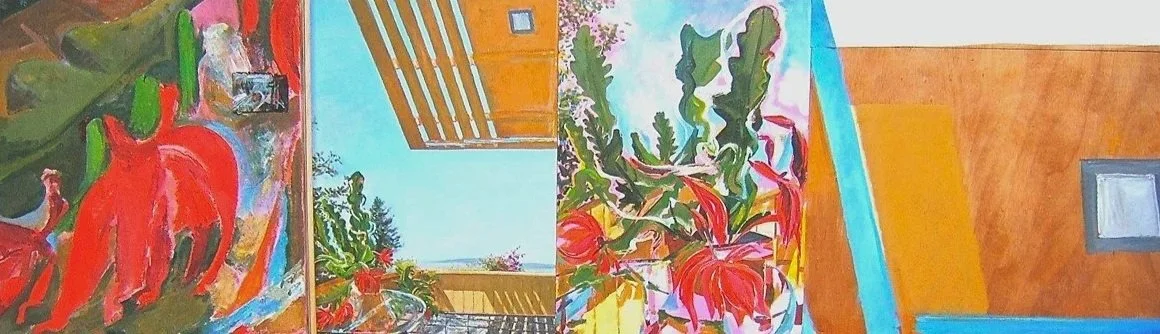
about
bill
“The inspiration also comes from serious thinking in the historical context in which we live and work. In a world so often gone mad, making these artworks is a way of thinking and trying to clear our heads. As Michael Baxandall writes in Patterns of Intention: On the Historical Explanation of Pictures, much of this thinking is peripheral or indirect, not that it is accidental or arbitrary. This is a kind of thinking according to the artwork as it emerges. Once more to Cézanne: ‘The landscape thinks itself through me.’”
—Galen Johnson
Selecting and organizing images of my work for this website presents a kind of time perspective. As images get sorted and lined up, a sequence develops, foreshortened but clear. Early work seen adjacent to the new constructions looks very different, showing particular pieces together would emphasize contrast and variety as a mode of development. I've carved wood, worked in clay, cast bronze, and painted in every medium there is, followed the call of geometry and process, figuration, and direct perception. At age eight or nine, I remember being attracted to working material with my hands, to the puzzle of its shaping, and the physical pleasures in crafting the object, which have never stopped. Study with brilliant teachers at Cooper Union and later at Yale among inspired classmates, amazing talent, and nascent fame. Unbelievable luck put me on that train, but that's a different story. I'm here now, rummaging through a lifetime of work with an objective to organize into coherent, written observation some idea, where I can't wave my hands to describe a potential insight.
In the beginning is the inchoate prompt: an almost secret intuition in the hands, to shape material—carve wood or draw a picture, pile rocks—to make something where there wasn't one before; it's magic. In the beginning, intuition and magic get you a ticket for the journey, while the long ride piles on technique and experience, method to the magic. "I look to think therefore I see", mangles Descartes' phrase in order to link looking and thinking. Looking, to make objects for seeing, must involve thinking about looking. The artist's ouroboros—to look to see how seeing looks. Archeological evidence shows that visual art has served many needs, that function has stimulated visual inventiveness. Among many other things, it's a record of a cognitive capacity to imagine form. Animal images at Altamira demonstrate the human ability to produce an anatomically realistic image of an animal seen and experienced in nature. In the smoky cave, the bison had to be imagined into visibility on the flickering wall, adjusted and coaxed into vitality, such power in eyes and memory.
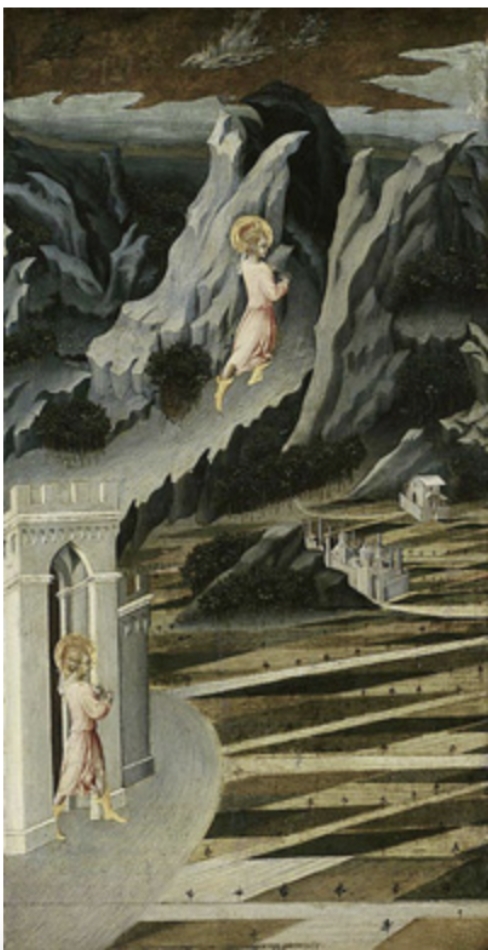
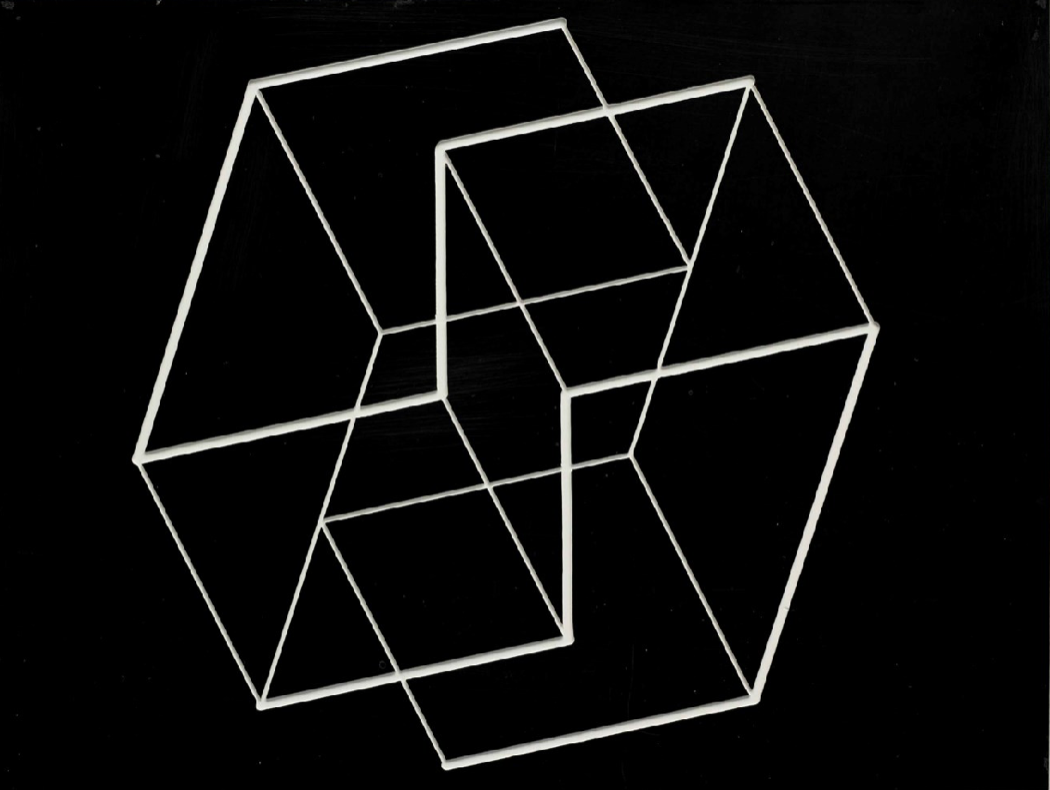
An abiding objective in graphic art presents to vision vitality and potential movement. Much of the visual material collected is geometric in design, rather than naturalistic verisimilitude, cave art notwithstanding. Geometry, repetition, and contrast seem to have a special place in optical cognition, a bond between what the eyes present and the brain 'enjoys'. The discussion below reflects on the eye/brain connection as we experience it, through the senses, and as a key to my studio preoccupations. What we sense as action and 'movement' in many graphic objects, like painting and drawing, comes about as optical signals to the brain that present an ambiguity, a shape needing reorganization by the 'mind'. The Necker Cube, a line drawing of an open cube, is a well-known clinical example of optical instability that, as you look, reverses its front-to-back orientation and back again. Joseph Albers (examples below) uses the method directly. The 'jumpiness' is at work in the 15th-century artist Giovanni di Paolo,
(who got his perspective wrong, in just the right way). He and Impressionist painter Paul Cézanne, "Madame Cézanne", used the method unconsciously, though Cézanne seems to have suspected something. The well-known graphic artist M. C. Escher elaborated on the simple optical illusion in spectacular ways. Their work offers an effect of 'unstable' shapes in a variety of ways: color contrast, edge relation, 'bad' perspective, and figure/ground reversal. Giovanni, whose Biblical narratives often indulge in sight gags (a nice moral ambiguity), is fond of contrasting patterns, incorrect perspective, illogical direction, and scale. Visual effects create constant optical activity, not activity 'illustrated'. The mastery with which Giovanni accomplished his compositions suggests that the optical effects were intentional, though not conceptualized. 'Optical activity', as described, is a hallmark of tribal art, is active in Renaissance figurative art, and is almost ubiquitous in modernist styles, indicating an elaborate eye/brain/mind connection worthy of attention.
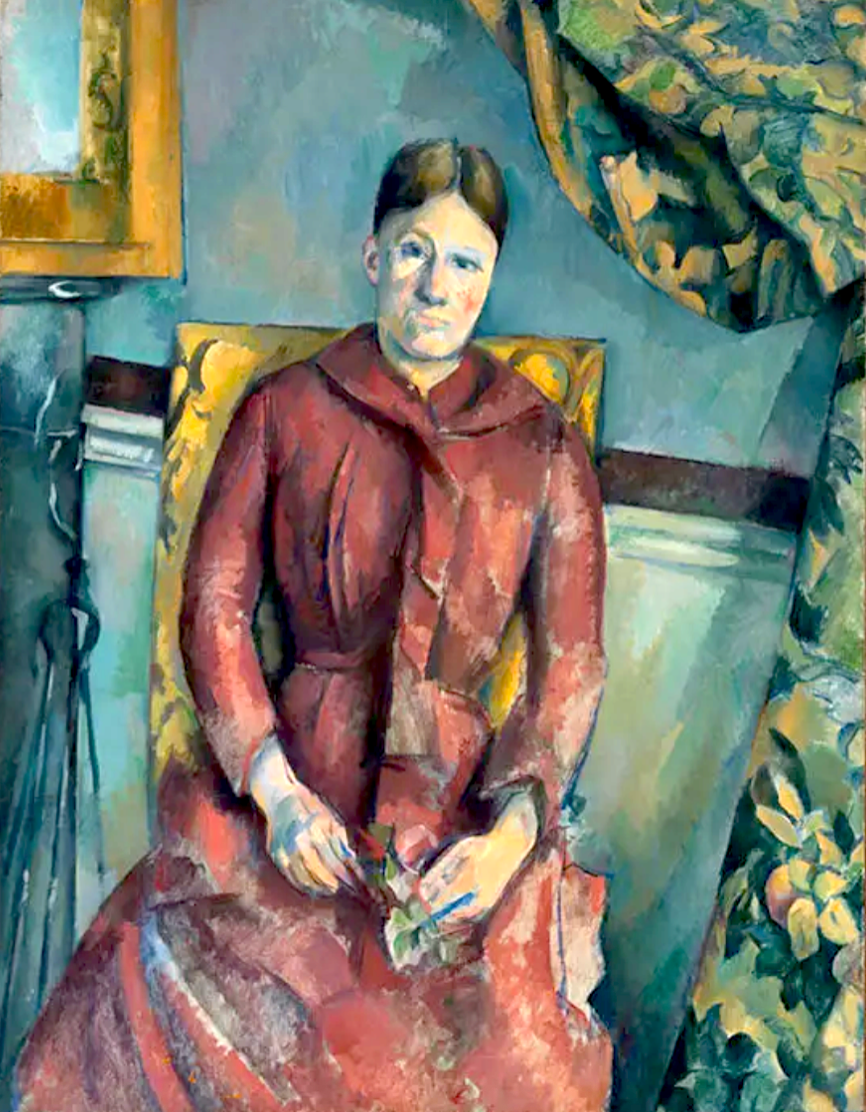
Western philosophical thought, from Platonic absolutism to 'modernist' Existentialism, has included intellectual consideration of artwork as an accepted (expected?) undertaking. In the 20th century, Phenomenology introduced the notion that we are 'embodied' in the world, that we come to consciousness through the fleshly connection of the senses. Experience in the physical world 'informs' consciousness. "To the things themselves!" Edmund Husserl says, abjuring metaphysical absolutes. Maurice Merleau-Ponty asserts our 'embodiment' in the world to be a critical basis of philosophic thought. His famous essay, "Cézanne's Doubt", considers the sources and ramifications of the painter's unique style.
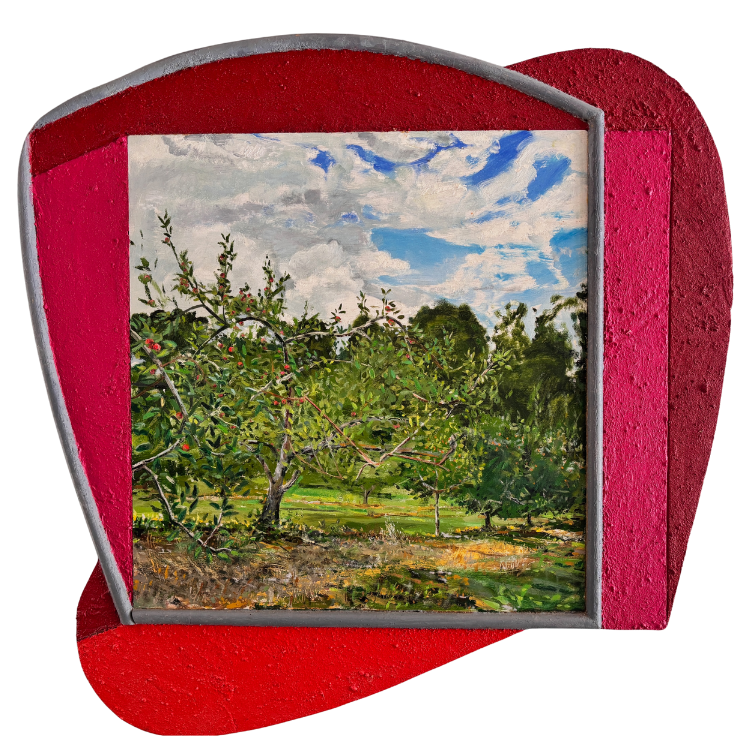
Cézanne's saying "I follow nature" and "I work in parallel with nature" is not surprising; he dragged a paintbox, canvas, a folding easel, and wine outdoors into the woods almost every day. Fellow artists report on Cézanne's long, concentrated stare before he put a stroke of color on paper or canvas. That quality of staring, in my experience, indicates a decision being made, beyond what painting a detail calls for. He abjured painting details in the traditional way. I've wondered, what in 'nature' was his focus? His response is succinct—"painting from nature is not copying the object, it is realizing one's sensations". The quote is misinterpreted, I think, when 'sensations' are taken to mean feelings or emotional reactions. Painting landscapes in the landscape is a physical, continuously taxing exercise. In my long years of plein-air painting experiences and research convinced me; 'sensations' are experienced bodily, can be isolated, recognized and used as Cézanne did. The artists' focus on visual structure, a cognitive act as subject, is the fulcrum upon which the history of painting has turned. Optical effects are things themselves!.
To experience landscape as a painter does is to view a thing of mutable parts, an unstable visual panorama; pattern recognition/interruption, shapes overlapping when shifting focus, parallax disjunction causing edges to get 'lost' or overlap, light intensity blurring outlines, the long stares' after-image, peripheral vision as a (interesting) distraction, focus and refocus as both visual and mental. Fortunate that for our existence, nature causes us to reflexively ignore a lot of interesting (peripheral) stuff. The Reptilian brain dictates our survival and fixes attention on food, aggression, and sex. It keeps people from enjoying the spaces' visual byplay that painters can't resist. Modernist painting theory in the seventies strove to eliminate 'space' and asserted that flatness is the true hallmark of advanced painting. In working studios, constraining definitions of what a painting could be disappeared long ago; some artists exiled paint itself. Personal pleasures and agitations, materials and concepts (also painters' things) are jostled now by the voluminous intrusion of a fraught world. What kind of space is that?
Perform this experiment: look at your palm as if to read the lines, but look 'through' the fingers with eyes focused on a distant object; now direct attention to how you see the hand.
These are parallax effects.
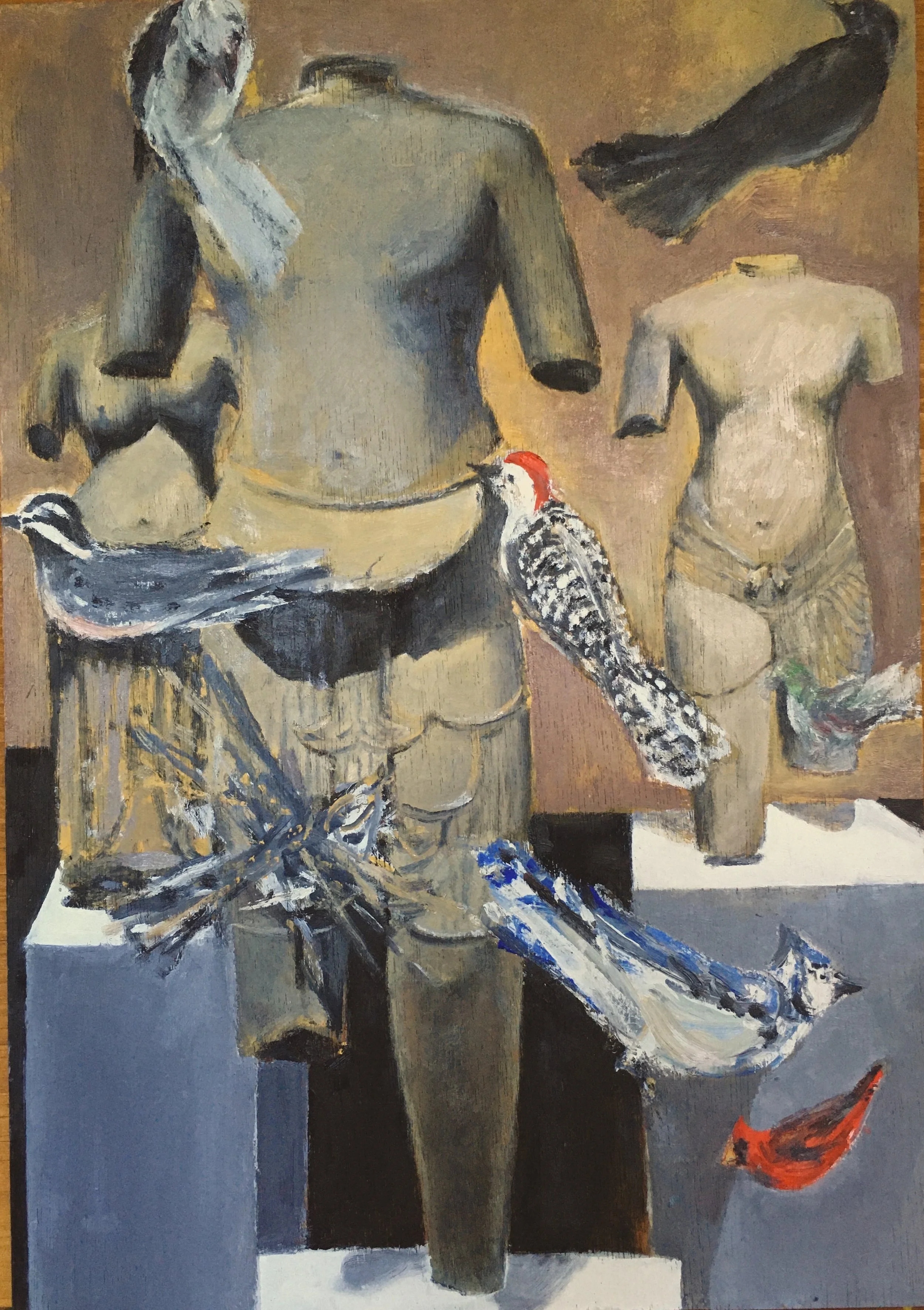
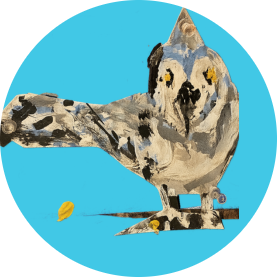
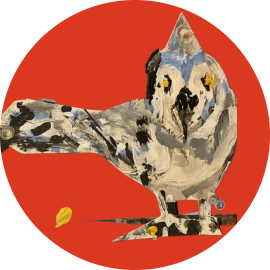
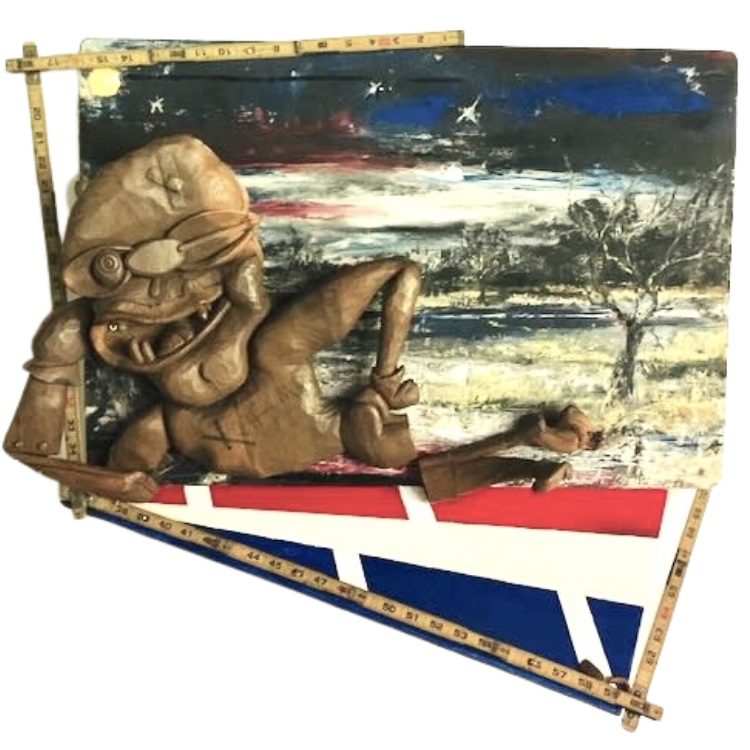
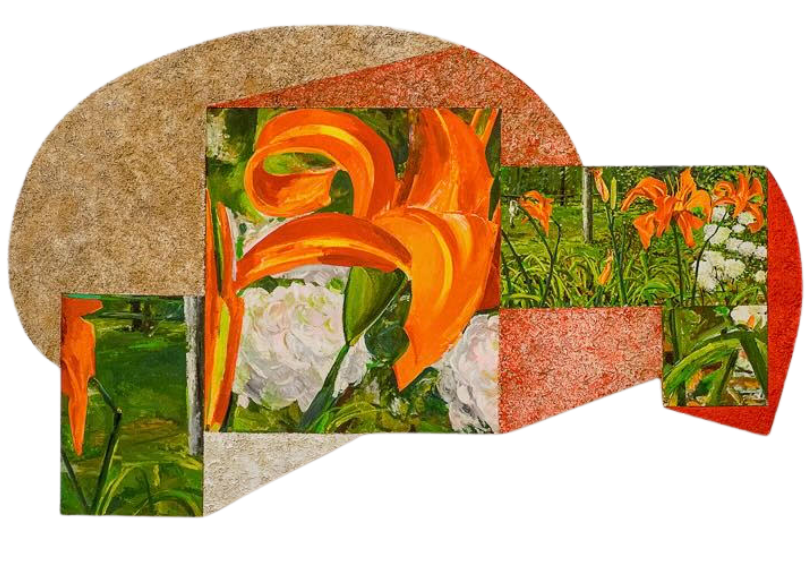
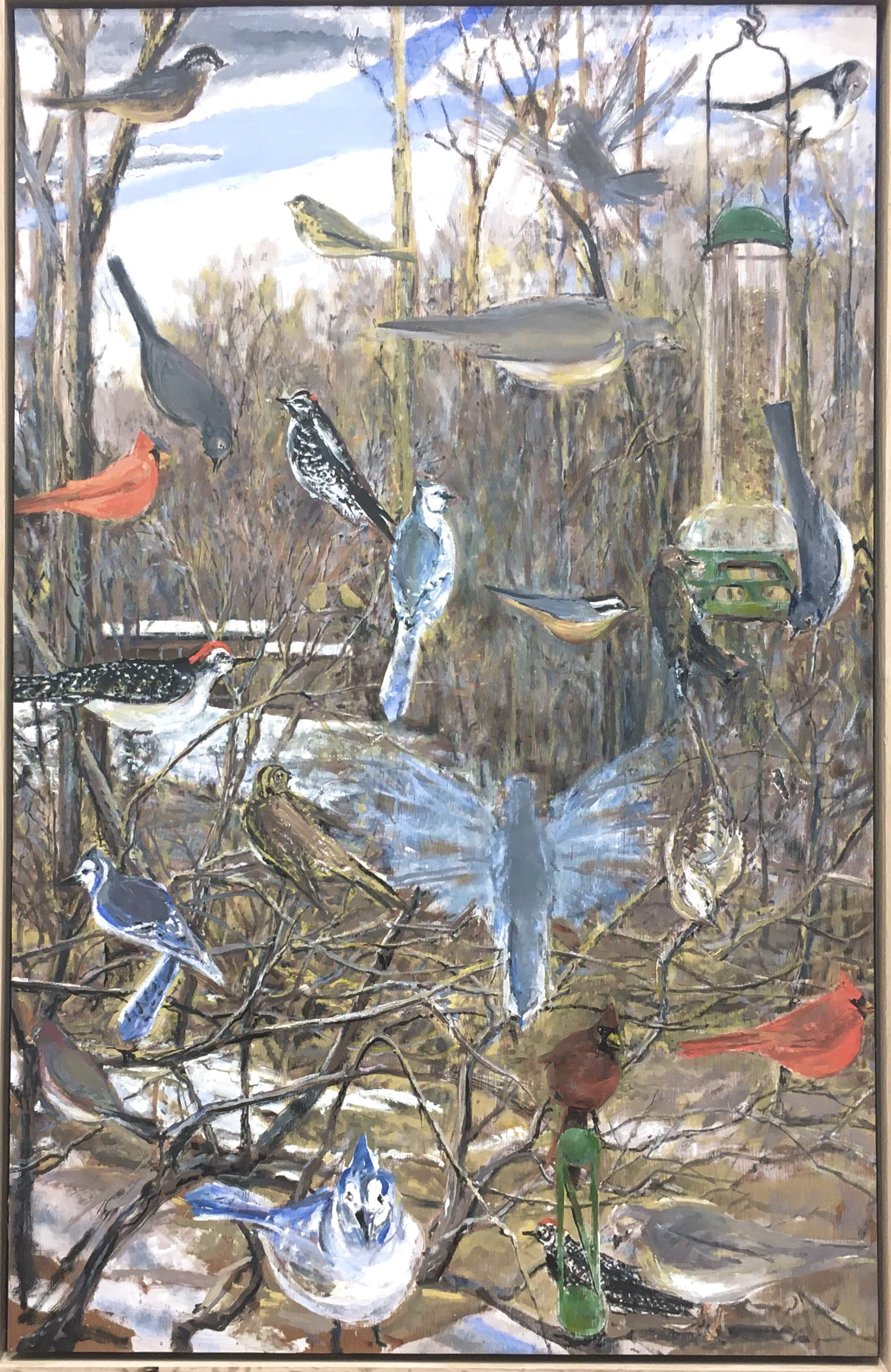
Two years ago, I started cannibalizing my own work. I treated paintings made years ago as 'found objects' to be included in new constructions, pasting cut-paper (collage) images into the paintings and painting into the new configurations. This breach of studio practice happened during COVID isolation. Attention to my bird feeders excited an interest to observe and paint the busy birds. Soon, bird paintings progressed from observed accuracy to calculated agglomerations, birds as color contrasts and landscape clues, a not unfamiliar, busy Cubist-like space. Realist vs. abstract is an uninteresting issue, as far as I'm concerned; it's all just real. How form behaves, what it does, how it moves, and how it combines into new meaning fascinate me. All the optics discussed above have informed my painting and sculpture. Overnight, almost to the hour, the borders broke (I'm tempted to say "the water broke") and anything could find its way into the compositions. My own paintings, as units of illusionistic space, are fitted into other images, perhaps wallpaper or a magazine photo cut into bird outlines. It all builds an unpredictable space, bird space.
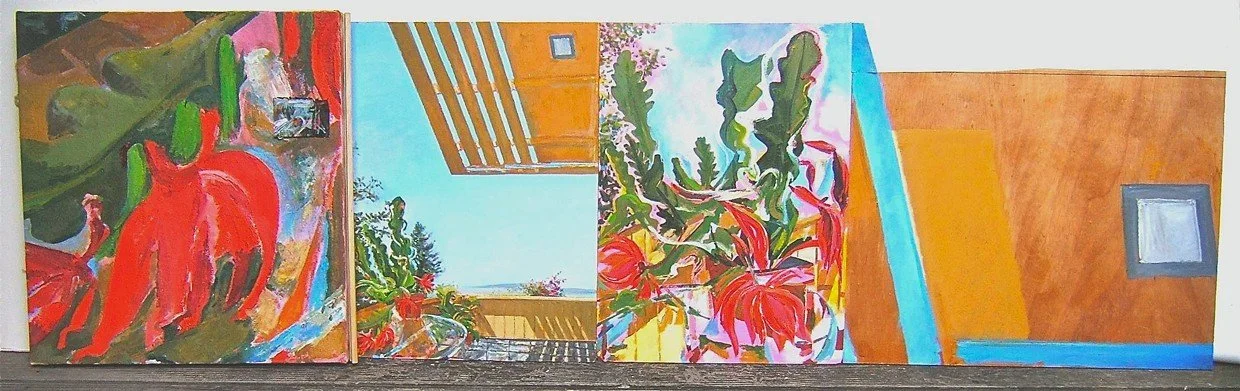
'Bird space' has no gravity, the horizon lines are everywhere, perspectives pile-up or disappear. Any detail or narrative cluster may derail the rush, hold still, and tell a story. Material things resist being illusions, but in peripheral vision the softer definition melds them into the image mixer. The new work has opened a conceptual door to unpredictable freedom in material and metaphor. generation. Every impulse spark a change in materials and calls for a different technique to bring it on. The constructions combine units of detailed images, clusters of narrative you might say, that if you move an inch, fly away to combine into new combinations of 'story line' or stop, disconnect, insist on being just its own shape & blob of matter. The optical engines, always ready to stretch with our material/illusionistic consciousness have, in the studio, become more varied and muscular, seeing vision consciously makes it GO!
CLIMBING
TREES
Then, it was all about climbing. At that age, every tree I saw was an adventure, shinny up the trunk or jump up to grab the lowest branch? And up high, at the skinny top to sway, to shiver in the fright, a boy's challenge.
Nowadays, we learn about subsoil communication among trees. In the soil everywhere, a fluffy white tough webbing, called mycelium, is knitted underground, sending signals, broadcasting chemical communication since forever. The notion that trees ‘associate’ together and with us, inside an eco-continuum connected and mutually interdependent, is an appealing proposal. Eden, a richly forested grove where we got into trouble, you know, the long-time-ago, fruit from the forbidden tree thing.
Fairy tales of children trapped in forests dark escaping by guile alone. Dark settings like the real, but suggestive, forests we gathered berries in. Close, thick pines rushed past the railcar windows, a chapter of my immigrant boyhood, repeated, forever stirred into stories and movies.
At DP (Displaced Person) camps in the American zone of post-war Germany, where we kids ran happily all over the springtime fields, neighboring towns showed films.
My first movie was a jungle adventure; Tarzan has to travel to New York after Jane is abducted, he must dive from the Brooklyn Bridge into the river to save her, and afterwards, he needs a new shirt. He tries one on at the store, there's a comic moment, and the shirt splits because his muscles are so big. Adventure, jokes, the hero romance, and the movies. My fate was branching out.
In Munich, I read American westerns in German. I read about the Mohawk and Iroquois forests of America, and my first novel was 'Uncle Tom's Cabin', in German translation.
Among the refugee cohort, a trained artist made a charcoal drawing of me, and I noticed that his skill was much admired. I watched a local artist painting landscape.
There were many American soldiers, some of them dark brown. I took them to be American, as I’d not yet learned about African people. Eleven days crossing the stormy Atlantic, retched over the railing to New York harbor—Bremerhaven to Brooklyn—January 1951.
Three days after arriving in the city, our ‘American’ cousins, to properly dazzle the ‘greenhorns,’ took us to Times Square to see a big hit movie.
The Jungle Book by Rudyard Kipling. Another jungle movie! It was spectacular! Gorgeous, color-saturated, newly invented Vistavision. A coming-of-age adventure; Mowgli, an Indian boy in a jungle, and a tiger, are enemies. In a cave filled with gold and jewels, greedy robbers get their comeuppance. And a film-first: a never-before filmed underwater fight, hero boy against tiger. Swirling movie magic and adventure in the forests, a fate against which there was no defense.
At many family events and immigrant gatherings, there was camaraderie, flirting, and food, leavened with the sad retelling of stories of escapes, loss, and heroism. Tales of partisans hidden in forests, fighting against Nazis.
Stirring songs of resistance and derring-do, like the girl in the forest of sparkling frost. The girl with skin like satin in the quiet, starry night, holding tightly in her hand a pistol. Waiting to ambush the German convoy.
The forest, the girl, the bullet, the heroic death, like myths immemorial, were conjured by my mother’s singing at those dinners in the Bronx. I clenched at hearing the sound, an operatic keening, and I squirmed. Why was I so embarrassed?
And then it came as uncontrolled feeling and emotion; sparkling frost, the girl’s heroic act, her beauty, her death, my mother’s public display, jumbled emotions, and then hot tears ran down my face, then, just as today. I'm still not out of the woods, tangled as mycelium in those ancient roots.
When I began drawing trees, the accuracy of detail and a photographic finish were most admired. The emotional forests of memory and movies flourished on their own hormonal tides, unconnected to what I was taught was 'real art,' printed in old books and new calendars.
I admired the precision my parents practiced as tailors, calculating and rendering garment patterns; I was taught the idea of ‘getting it right.’ Eventually, intense art school education and a would-be bohemian art scene baptism taught me to also get it properly ‘wrong.’
To tell the truth about all this or its possible influence on maturity, or on me as an artist, is impossible. Who knows? Does it teach anything? Or is it another story added to the campfire, a signal?
THE BIRD
SPACE
Landscape, birds, and space: a long introduction to a short punch line.
Landscape painting, as it emerged in the 15th century, steadily developed into a separate genre. Painting traditions that utilized landscapes as settings for realist narrative and symbolic content allowed landscape to evolve as a genre in itself. Proto-scientific and social challenges fueled the new 'realist' geometric calculations for vanishing-point perspectives. Burgeoning invention in the material world was mirrored by the inventiveness in artists’ studios.
Art historians and the ‘scientific’ method found analysis and classification useful in ordering the maelstrom of change. Paintings were soon slotted into stylistic cubbies—Naturalist, Impressionist, Expressionist—among many others. While subject matter continued as before, traditional painting techniques faded. Materials handling and ‘painterly issues’ were yoked to individual invention, a personal expressive space.
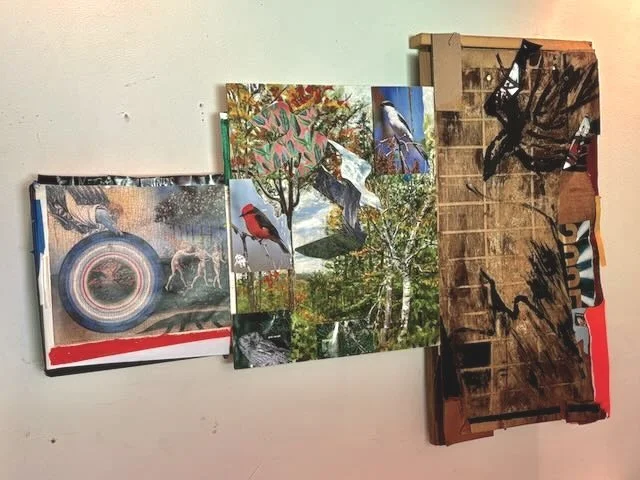
Consider three examples: classic Chinese landscape painting or a mountain view by Cezanne or Caspar David Friedrich. While very different, each presents aspects of landscape details and great distance. But ‘space,’ as artists use the term, is something else. It includes the manner of material handling, a choice in the stability of optical presentation, and, of course, the full range of realist to abstract imagery. The ideal illusionism neoclassical painting strove for an uninflected, smoothly painted surface.
Contrarily, modernist paintings often foreground the material’s thingness, putting it in tension with the simultaneous illusion of the image. The tension becomes an active component of ‘space.’ The landscape surveilled (‘real’ landscape?) is both form and optical prompt (light, color, size), the painting stimulates a unique space, not a simulacrum but an action. To put it simply: the real landscape and the real painting are different realities. No news there! It has always been thus; the art space is a different reality in the many ways we understand that word.
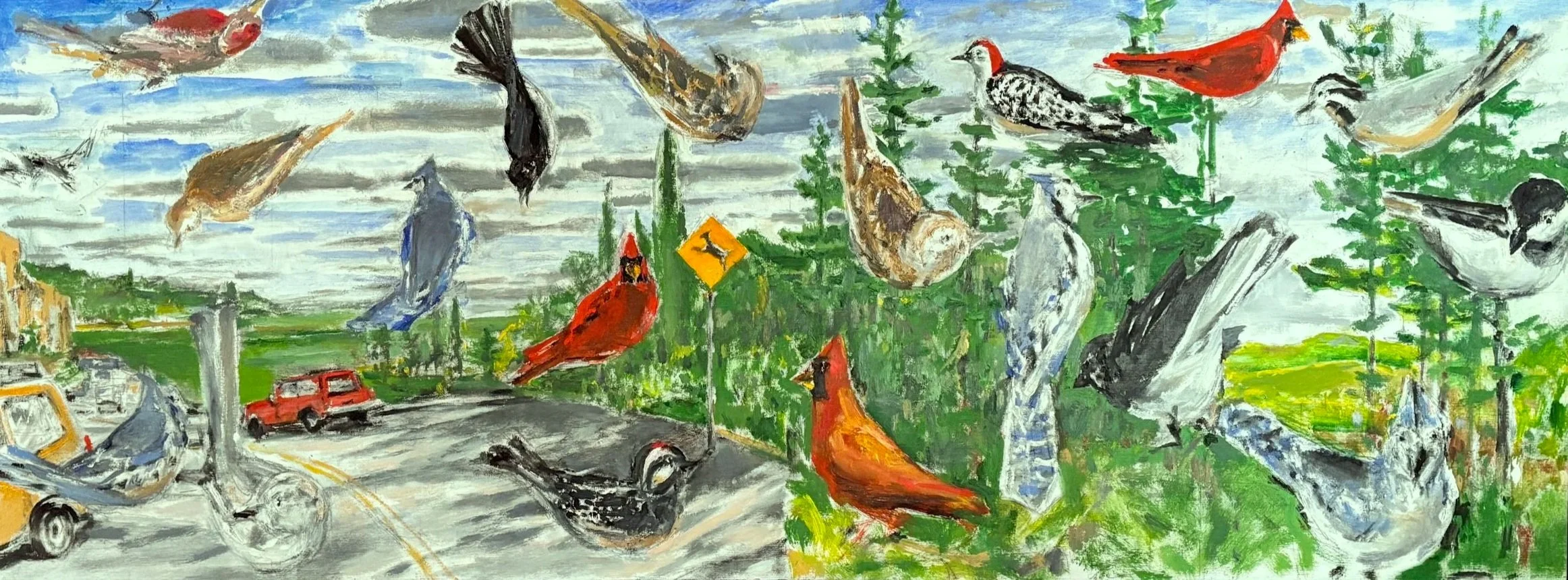
The bird feeder at my studio window concentrated my perception of the bird's temporal and physical action, ‘painterly issues’ I'd not anticipated now intruded. How to paint them? Audubon illustrations, taxonomic ordering? Gymnastic photo-blur? A year into the project of steady observation had me realize that birds were not susceptible to gravity. Up or down, right or left, didn't concern them. Their space had no horizon line, and the vanishing points were everywhere. I painted birds in different spaces until the birds taught me to experience a new ‘space.’ Bird space!